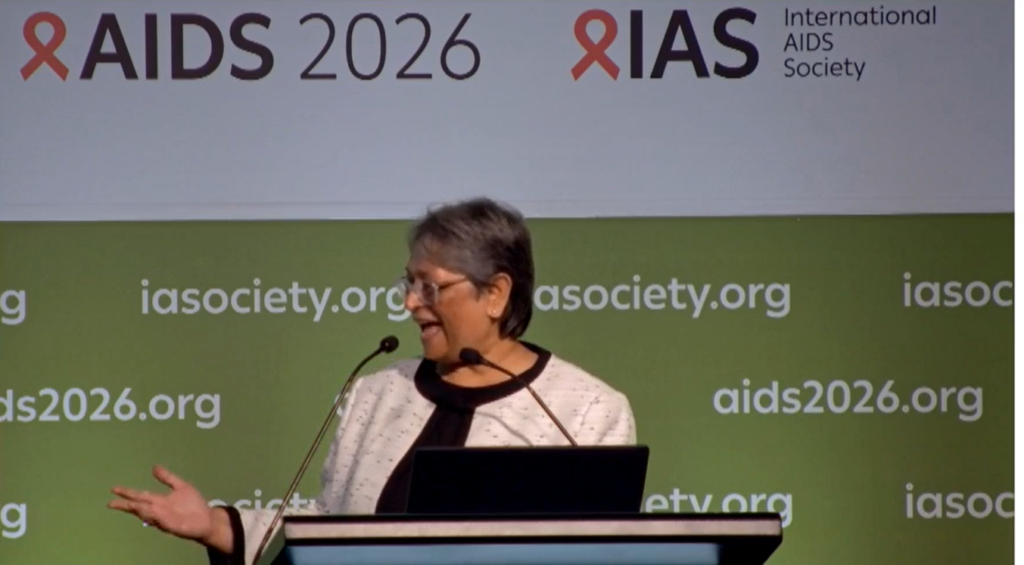

At the 26th International AIDS Conference in Rio de Janeiro, a plenary session titled “New realities, new responses” posed an important question: is AI the next breakthrough for the HIV response, or just the next buzzword? A related thread also ran through the session: how to help millions of people ageing with HIV live well, not just longer. The session explored whether the HIV response can scale its solutions as fast as its problems are changing.
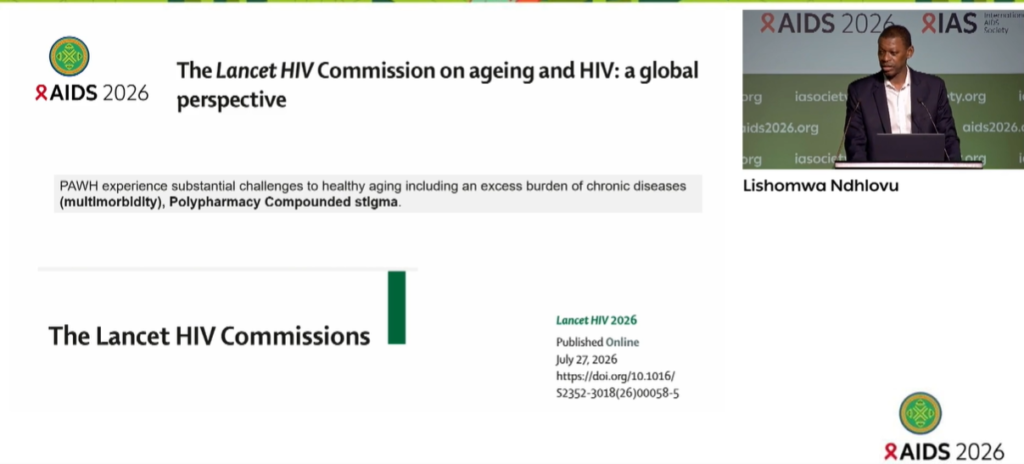
For Lishomwa Ndhlovu, a professor of medicine at Weill Cornell Medicine, the challenge in advancing healthy ageing among people living with HIV goes beyond helping people live longer. It is ensuring that they can maintain the physical and mental functioning that allows them to do the things they value as they age.
The proportion of people living with HIV who are older than 50 is increasing, creating a greater need to address age-related health conditions in this population. Ndhlovu noted that the challenges are worsened by stigma and the social realities that can accompany ageing, including isolation and living alone.
Researchers are looking for better ways to measure biological ageing in people living with HIV. Ndhlovu pointed to emerging biomarkers that could help identify people at higher risk of age-related complications. Epigenetic clocks are another area of interest. They allow researchers to compare a person’s biological age with their chronological age. Early research is exploring whether these measures could eventually help track changes associated with treatment and other interventions.
Giving a presentation on “Harnessing AI for HIV: The Next Breakthrough or the Next Buzzword?”, Izukanji Sikazwe Sikaulu, a Zambian infectious disease physician, noted that AI is not new to the HIV response. It has been used for years in areas such as HIV surveillance, modelling, supply chain management and adherence support. However, she flagged the problem of moving from innovation to scale.
“One of the big questions that I struggle with in my life in HIV programming is where have all the innovations gone? How do we move from pilots to implementation at scale? We run brilliant pilots… and then they stall. We get promising results, but have no plans, no funds to implement them at scale. The exciting part is improving something that works once and being able to make it work everywhere, every day, for everyone. Scale is where real impact lives. This means moving past the pilot’s graveyard and building for implementation from the very beginning.”
~ Izukanji Sikazwe Sikaulu
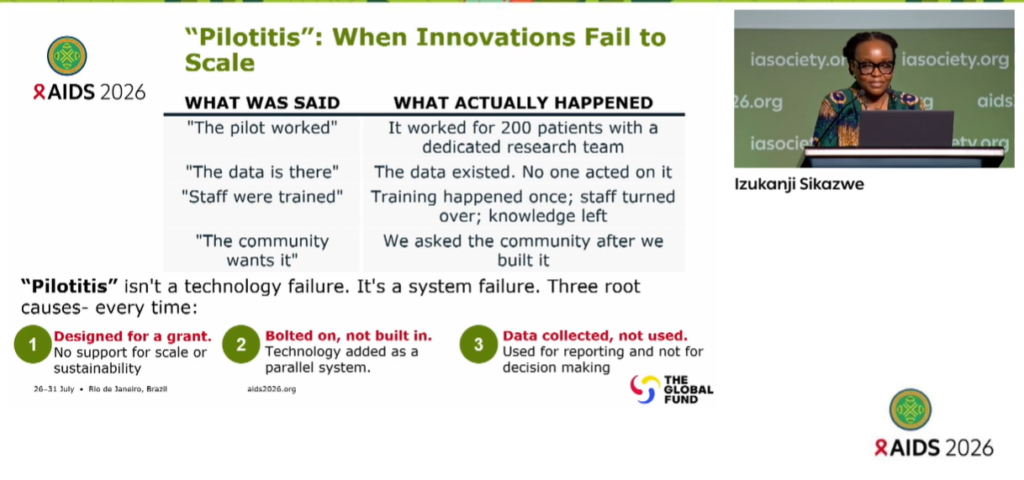
For Sikaulu, this is a systems problem. Innovations are often designed around grant cycles rather than health systems. They are added as parallel systems instead of being integrated into existing structures. Data may be collected without being meaningfully used, while staff who were trained during a pilot leave without a plan to build capacity among those who replace them.
Sikaulu identified governance, bias, inequity, privacy and trust as key issues that must be addressed as AI becomes more widely used in health systems.
Another question is who controls the technology and data behind it. Before AI tools are introduced into public health systems, countries need clear answers about who owns the tools, who governs the data and who is responsible for oversight.
The discussions on healthy ageing and AI may appear to address very different parts of the HIV response. One is focused on the biological and social realities of people living longer with HIV. The other is concerned with technology and the future of health systems. But both point to the same conclusion: the HIV response cannot remain static.
The next chapter of the HIV response calls for sustained investment, stronger health systems, meaningful community involvement and willingness to build solutions that work beyond the pilot stage.
Subscribe to Africa Health Watch
Get the latest health policy analysis and investigative journalism delivered straight to your inbox.
We respect your privacy. Unsubscribe at any time.